
Where Is Diesel Cheapest in India? State-by-State Refuelling Guide
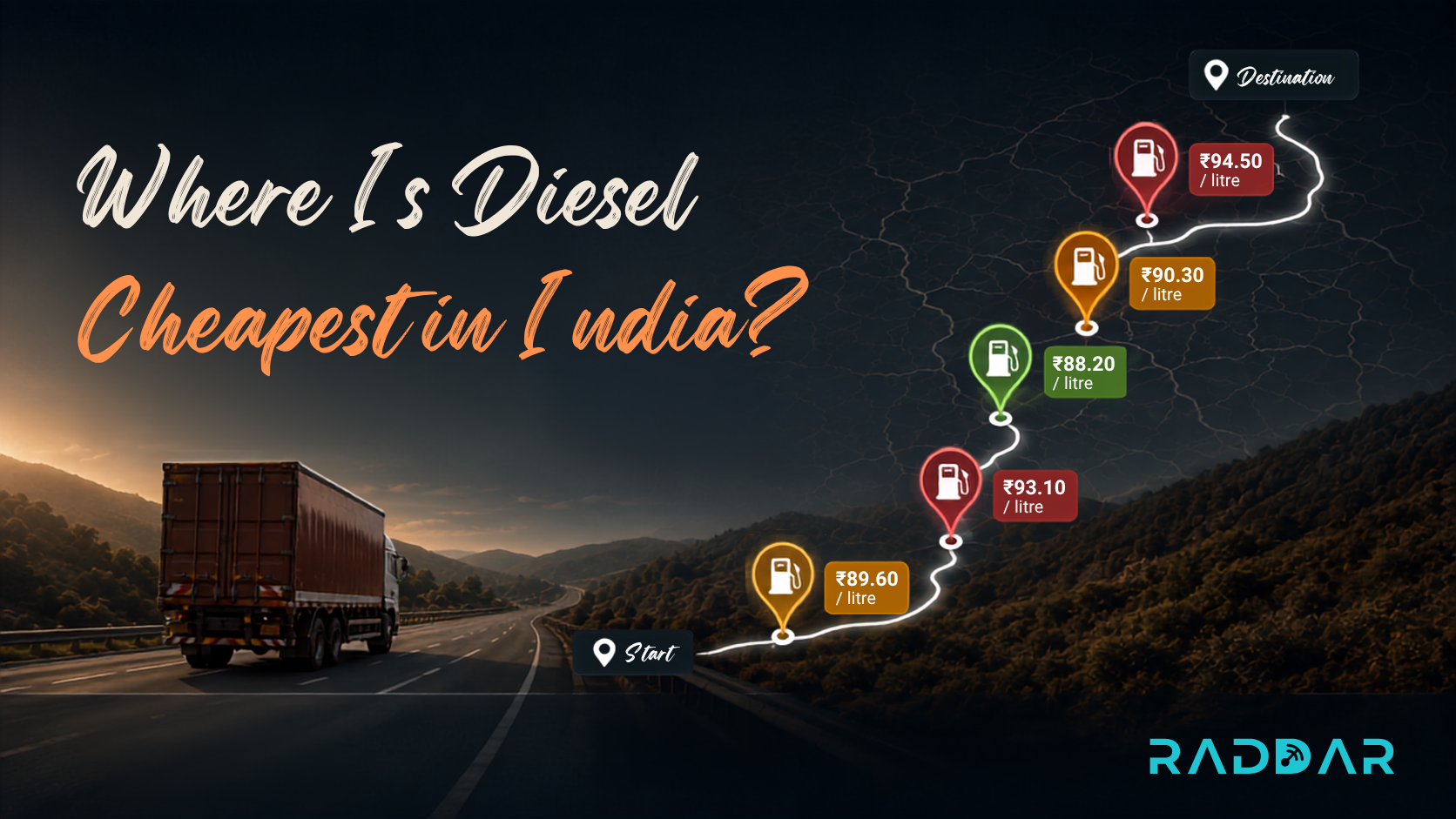
How Much Can Truck Owners Save by Comparing Diesel Prices Across States?
Quick answer: Diesel prices can differ by ₹5–9 per litre between states, mostly because of state tax (VAT). If a truck runs 15 interstate trips a month, checking prices before each fill-up can save around ₹15,000–₹22,500 a month. That's often enough to cover a truck loan EMI.
Most truck owners already know that diesel prices change from state to state. What's harder to see is how much that adds up to over a month of regular trips. This article works out the number, using data from India's official fuel price source.
Why Does Diesel Cost Different Amounts in Different States?
The base price of diesel is the same across India. What changes is the state tax (VAT) added on top, and every state sets its own rate. That's why the same diesel can cost more in one state than another, even though it comes from the same source.
The Petroleum Planning & Analysis Cell (PPAC), under India's Ministry of Petroleum & Natural Gas, publishes diesel prices for every state every day. It's the official source for numbers like these.
As of 08 September 2026:
State | Diesel price |
|---|---|
Delhi | ₹95.20/litre |
Hyderabad | ₹103.82/litre |
Difference | ₹8.62/litre |
That's one of the biggest gaps in the country right now. But a ₹5–9/litre difference between neighbouring states is common.
What That Difference Costs on One Trip
The math is simple:
Fuel needed = Distance ÷ Mileage Fuel cost = Fuel needed × Diesel price
Most loaded trucks in India get 3–5 km per litre, depending on the truck, the load, and the road. Say a truck needs 300 litres for a trip:
Fill-up location | Price/litre | Cost for 300L |
|---|---|---|
Delhi | ₹95.20 | ₹28,560 |
Hyderabad | ₹103.82 | ₹31,146 |
Difference | ₹2,586 |
Same fuel. Same truck. Same trip. The only thing that changed is which state the diesel was bought in. Diesel usually makes up 40–50% of what it costs to run a truck in India, so a gap this size is not small change — and closing it doesn't need a new route or a new customer.
Why Owners Still Fill Up at the Same Pump
This usually isn't about not knowing — most owners already know prices differ by state. It's about credit. A trusted local pump lets them run a tab (udhaar), so they don't have to pay cash on the spot. For an owner with one or two trucks, that matters. It's not a bad habit.
It's just a habit nobody has put a number on. Most owners have never worked out what staying loyal to one pump actually costs them over a month.
What a Realistic Monthly Saving Looks Like
The ₹2,586 example above uses the biggest gap in the country, so treat it as the high end, not the everyday case. On a more typical route — a ₹6–7/litre gap, and a partial 200–220 litre top-up in the cheaper state — the saving works out closer to ₹1,500 per trip.
Two numbers, so you can swap in your own:
₹1,500 saved per trip
15 trips a month (about one every two days, a normal pace for a single truck doing regular interstate runs)
Amount | |
|---|---|
Saving per trip | ₹1,500 |
Trips per month | 15 |
Monthly saving | ₹22,500 |
Yearly saving | ₹2,70,000 |
For comparison: a ₹10 lakh truck loan over 5 years at 10% interest costs about ₹21,250 a month in EMI. On these numbers, the diesel saving alone could cover that EMI.
(These are example numbers — your actual saving depends on your route, how much you fill up, and the day's prices. Check the real gap on your route with RADDAR's Diesel Rate Calculator, and see what it means for your loan with the Loan EMI Calculator.)
Fuel Prices Also Affect What You Earn, Not Just What You Spend
It's not only the gap between states that matters — how prices move over time affects your costs too. IFTRT, a Delhi-based truck research group whose numbers are often quoted in the financial press, tracked a period when Delhi diesel prices rose by about ₹11/litre over eight months. That alone added close to ₹6,930 to the cost of one Delhi–Mumbai–Delhi round trip.
That time, truck rental rates went up enough to cover the extra cost. But IFTRT has also recorded times when fuel prices rose faster than freight rates could keep up — which is why it helps to track the number per trip, instead of assuming it evens out over time.
Know the Gap — You Don't Have to Change Pumps
None of this means giving up your credit pump. The cash-flow help is real, especially if you run one or two trucks. It just means knowing the price gap before you decide how much to fill, and where.
Two things owners do:
Fill more in the cheaper state. Still do a smaller top-up at the credit pump if that's what keeps the account active.
Check the gap on your usual route, so the decision is based on today's actual prices, not a guess.
RADDAR's Diesel Rate Calculator shows you today's diesel price in every state, so before your next trip, you know exactly how much more — or less — you'd pay depending on where you fill up. It won't tell you to change your route or drop your pump. It just shows you the number.
Frequently Asked Questions
Which state has the cheapest diesel right now?
It changes every time prices are revised, so there's no fixed answer. Delhi has usually been on the cheaper side because of lower state tax. Check RADDAR's Diesel Rate Calculator for today's numbers on your route.
Why do diesel prices differ between states in the first place?
Each state sets its own tax on top of the same base fuel price. That tax difference is the whole reason for the gap — the diesel itself is identical.
Is it worth switching my regular pump for cheaper diesel?
You don't have to switch. Keep your credit pump for smaller, routine top-ups, and fill more of your tank in whichever state on your route is cheaper that day.
How do I work out diesel cost for a trip?
Divide the distance by your truck's mileage to get litres needed, then multiply by the diesel price where you fill up. Example: 1,000 km ÷ 4 km/L × ₹90/L ≈ ₹22,500.
How much does this actually save over a month?
On a conservative ₹1,500 saved per trip and 15 trips a month, that's about ₹22,500 a month — often enough to cover a mid-size truck's EMI. Your real number depends on your route and how much fuel you shift to the cheaper state each trip.
From the team at Raddar
Raddar is transport management software built for Indian truck operators — trips, bilty / LR generation, GST invoicing, FASTag tracking, and driver WhatsApp updates, all in one place.